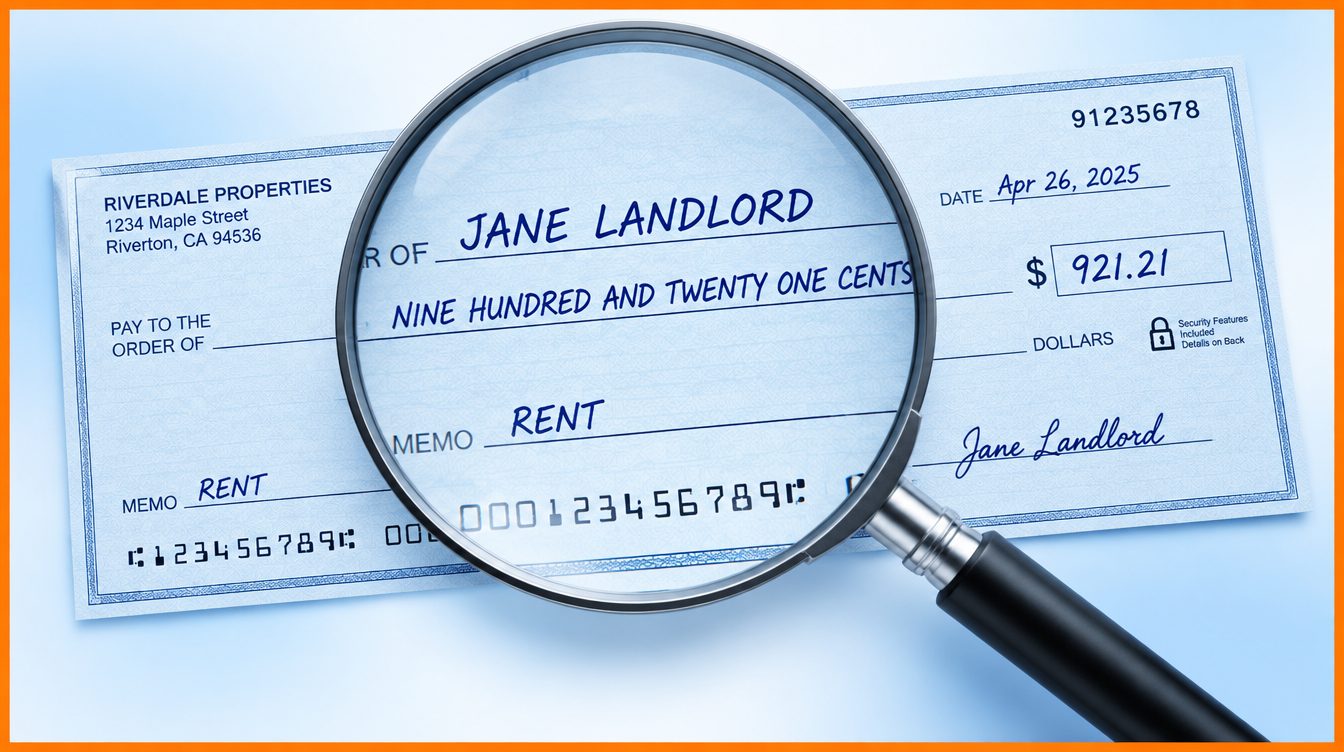
Where Is the Routing Number on a Check?

A routing number is the nine-digit code that tells the banking system which institution holds your money. It is the first thing a payroll form, a direct debit setup or a wire instruction asks for, and it is printed on the bottom-left of every check you own.
The number itself is easy to find. The part that goes wrong is which routing number — most large banks have several, and the one on your check is frequently not the one the form wants.

Where it is on the check
Look at the bottom edge of the check, at the line of oddly-shaped digits. That is the MICR line — magnetic ink character recognition — and it is printed in a font machines can read. It contains three numbers, always in this order, reading left to right:
| Position | What it is | Length |
| First (bottom-left) | Routing number | Always 9 digits |
| Second (middle) | Account number | Usually 8–12 digits, varies by bank |
| Third (bottom-right) | Check number | 3–4 digits, matches the top-right corner |
The routing number is bracketed by a pair of identical symbols that look like a colon next to a vertical bar. Those brackets are the reliable marker: whatever sits between them is the routing number, regardless of how the check is laid out.
The nine-digit rule is the fastest check you can run. Count the digits. If you have nine, it is the routing number. If you have eleven, you are looking at the account number.
Which routing number the form wants
This is where the real confusion lives, and it is not the reader's fault. Your bank may have issued several routing numbers, and they are not interchangeable.
- ACH / paper routing number. The one printed on your check. Use it for direct deposit, automatic bill payment, transfers between banks, and anything a payroll department asks for.
- Wire transfer routing number. Often different, and usually not printed anywhere on the check. Large banks run domestic wires through a single national number rather than the state-level one. Using the check number for a wire is the most common reason a wire is returned.
- State-specific numbers. Chase, Bank of America and Wells Fargo assign routing numbers by the state where the account was opened. If you opened your account in Texas and now live in Oregon, your routing number is still the Texas one.
- International. A routing number is a domestic code and means nothing outside the United States. Money arriving from abroad needs a SWIFT/BIC code instead.
If a form asks for a routing number without saying which kind, it almost always means ACH — the one on your check. If the word "wire" appears anywhere on the form, stop and look up the wire number separately.
Finding it when you have no checks
Most people under thirty have never held a checkbook. Every one of these works:
- Your banking app. Open the account, find account details or account information. Both numbers are there, usually with a copy button. This is the most reliable source there is.
- A paper or PDF statement. Printed in the header block near your account number.
- The bank's own website. Every major bank publishes a routing number page. Search the bank's name plus "routing number" and click through to the bank's own domain, not an aggregator.
- Call the number on the back of your debit card. Slow, but it works, and the answer is authoritative.
If you bank with Chime, Cash App or another app
App-based accounts still have routing numbers, but the number belongs to the chartered bank behind the app rather than to the app itself. Chime accounts route through its partner banks; Cash App balances route through its own partner. The number shown in the app is the correct one to give out — you do not need to know the partner bank's name to use it.
One consequence worth knowing: because these routing numbers belong to a small number of partner banks shared across many fintech products, some employers' payroll systems and some government agencies handle them inconsistently. If a direct deposit is rejected and the numbers were right, that is usually why.
Is it safe to give out?
Routing numbers are public information. They are published by the Federal Reserve, printed on every check a business sends out, and listed on bank websites. On its own, a routing number is harmless.
The risk is the pair. Routing number plus account number is enough to set up an ACH debit against your account, which is exactly how the system is designed to work. Give both together only to parties you intend to pay or be paid by — an employer, a utility, a landlord — and never in response to an unsolicited call or message.
Verify before you send money
Every routing number on this site is checked against two sources: the bank's own published page and the Federal Reserve's E-Payments Routing Directory, which is the authoritative registry. Aggregator sites copy from each other and are wrong often enough to matter.
Whatever page you are reading, including this one: confirm the number in your own banking app before you send money. It takes fifteen seconds, and a misrouted transfer takes weeks to unwind.
Related
For international transfers you need a SWIFT code instead. For the middle number on the same line, see where the account number is. Once you have both: endorsing a check, how long a check takes to clear, and how to write one.
Common questions
How many digits is a routing number?
Always nine. If the number you have is not exactly nine digits, it is not a routing number — it is probably the account number, which varies in length.
Is the routing number the first or second set of numbers on a check?
The first. Reading the bottom line left to right: routing number, then account number, then check number.
Does my routing number change if I move to another state?
No. It is tied to the state where you opened the account, not where you live now. Moving does not change it.
Can one bank have more than one routing number?
Yes, and most large ones do. Chase, Bank of America and Wells Fargo assign a different number per state, and nearly every large bank uses a separate routing number for incoming wire transfers.
Where do I find my routing number without a check?
In your banking app under account details, at the top of a paper statement, or on the bank’s own routing number page. Do not use a third-party lookup site.
Figures and rules in this article are checked against the official sources below. Where they disagree with us, they win.