How to Write a Check, Step by Step

Checks are no longer the everyday payment method, but they have not disappeared. Landlords, contractors, government offices and private sellers still ask for them, and a check filled in wrong gets returned, held, or in the worst case altered.
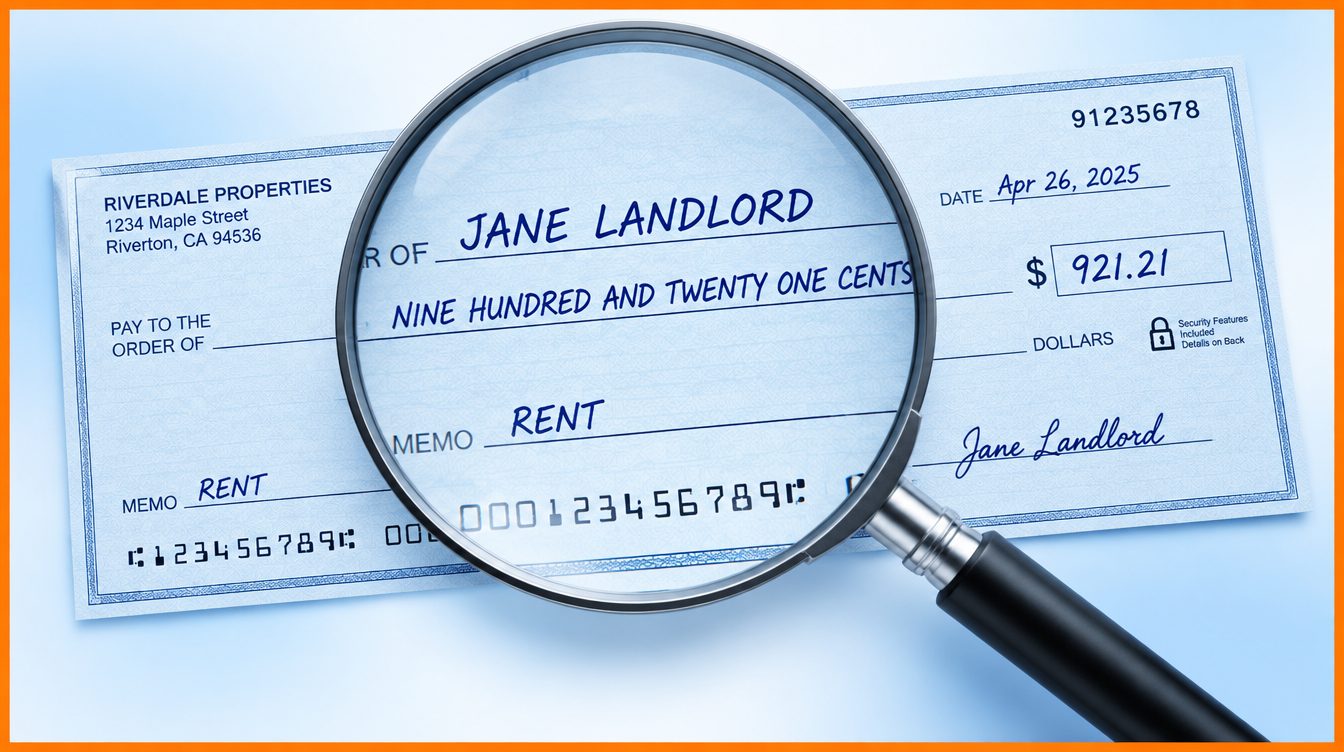
There are six fields. Here is what goes in each, and which three actually matter.

The six fields
- Date — top right. Today's date. Write it in full rather than abbreviating the year.
- Pay to the order of — the recipient's name, in full. For a business, use the business's legal name, not a shortened version.
- The amount box — the small box on the right, in figures. Start hard against the left edge of the box and leave no gap.
- The amount line — the long line beneath the payee, in words. This is the field that legally controls the amount.
- Memo — bottom left. Optional, no legal weight. Useful for an invoice or account number so the recipient applies the payment correctly.
- Signature — bottom right. Must match the signature your bank holds on file. An unsigned check is not a payment.
Writing the amount line correctly
This is the field people get wrong. The convention is the whole dollars in words, then the cents as a fraction over 100, then a line through the remaining space.
| Amount | In the box | On the line |
| One hundred dollars | 100.00 | One hundred and 00/100 ———— |
| Forty-two dollars fifty | 42.50 | Forty-two and 50/100 ———— |
| One thousand two hundred five dollars | 1,205.00 | One thousand two hundred five and 00/100 ———— |
Draw a horizontal line through any space left over. An empty stretch of line is an invitation to add words.
The reason the words matter: if the figures and the words disagree, the words win. That is not a bank policy, it is the Uniform Commercial Code. A check with 42.50 in the box and "four hundred and 25/100" on the line is a four-hundred-dollar check.
The three mistakes that cost money
- Leaving gaps. A space in front of the figure in the amount box lets someone add a digit. A 100 with room to its left becomes 4100. Start at the left edge and fill the line.
- Signing a blank check. A signed check with no payee and no amount is a bearer instrument for whatever the holder chooses to write. Never sign in advance, including on checks you are carrying loose.
- Using a pencil or erasable pen. Blue or black ballpoint. Gel pens and erasable ink can be lifted off cleanly with solvent.
If you make a mistake
For a minor error outside the amount and payee fields, strike a single line through it, write the correction alongside and initial it. Be aware some banks refuse visibly altered checks, so this is a gamble on the teller.
For anything on the amount line, the amount box or the payee line, do not correct it. Write VOID across the check, tear it out, keep it until you have reconciled the account, and write a new one. The check number sequence will show a gap, which is what the register is for.
After you write it
Record the check number, date, payee and amount somewhere — the register in the back of the checkbook, or a note on your phone. A written check can sit uncashed for months, and an unrecorded one is how an account gets overdrawn by a payment made in March and deposited in July.
Banks are not required to honour a personal check more than six months old. Many still will, at their discretion. If a check you wrote has not cleared after a few months, contact the recipient rather than assuming it has been forgotten.
Related
If someone has asked you for a voided check rather than a written one, that is a different job — see how to void a check. For the numbers along the bottom edge, see the routing number and the account number.
After it is written: how to stop payment if you need to cancel it, and what happens when a check bounces.
Common questions
Which amount counts if the numbers and words disagree?
The written words. Under the Uniform Commercial Code the words control when the two fields conflict, which is why the word line exists at all.
Do I have to fill in the memo line?
No. It has no legal effect and the bank ignores it. It is a note for you and the recipient.
What happens if I make a mistake?
For a small error, strike it through, write the correction and initial it — though some banks refuse altered checks. For anything on the amount or payee lines, void the check and write a new one.
How long is a check good for?
Banks may refuse a personal check more than six months old. Many still honour them, but they are not obliged to.
Can I postdate a check?
You can write a future date, but it does not reliably stop the check being cashed early unless you give your bank separate written notice.
Figures and rules in this article are checked against the official sources below. Where they disagree with us, they win.