
Fidelity Go Review (2026): Is It Worth It?
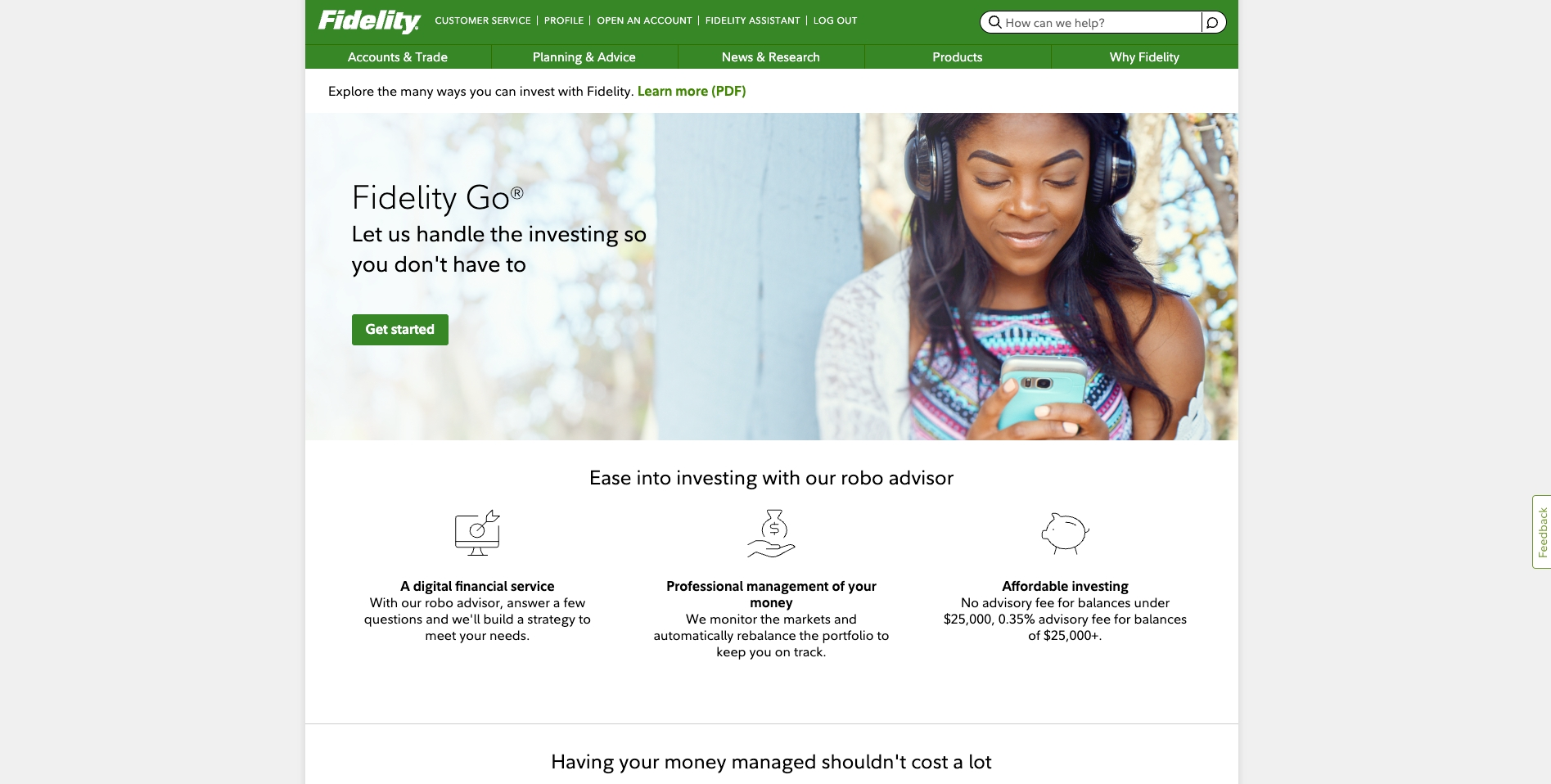
Below $25,000 it is genuinely free. No advisory fee, and the underlying Fidelity Flex funds charge a 0.00% expense ratio — so your total cost is zero, which no competitor matches.
At $25,000 a 0.35% advisory fee applies to the whole balance, and you gain unlimited calls with a Fidelity adviser. That is a step, not a taper: crossing the line is a real change in cost.
Above the threshold it stops being the cheap option. Betterment and Wealthfront charge 0.25%, and their ETF expense ratios are smaller than the 0.10% fee gap. If you will not use the coaching, that is where to look.
Fidelity Go is Fidelity’s robo-advisor: you answer a risk questionnaire, it builds and rebalances a portfolio of Fidelity funds, and you never choose a holding. What distinguishes it is not the portfolio, which is conventional, but the pricing — a free tier that is genuinely free, and a threshold above which it is no longer the cheapest thing available.
Most of this review is about where that line sits and what happens on either side of it.
The short version
| Advisory fee | $0 below $25,000; 0.35% a year at $25,000 and above |
| Fund expense ratios | 0.00% — it holds Fidelity Flex mutual funds |
| Minimum to open | $0, though it needs $10 before it invests |
| Human advice | Unlimited 1-on-1 calls, at $25,000 and above only |
| Tax-loss harvesting | No |
| Account types | Taxable, Roth IRA, traditional IRA, rollover IRA, HSA |
| Best for | A first managed account under $25,000, especially if you already bank with Fidelity |
Why the free tier is actually free
Robo-advisors normally charge two layers: an advisory fee, plus the expense ratios of the ETFs they buy on your behalf. The advertised fee is only part of what you pay.
Fidelity Go removes both. There is no advisory fee under $25,000, and it invests in Fidelity Flex funds, a share class built for exactly this purpose with a 0.00% expense ratio. The total is zero, and that claim survives inspection in a way that most "no fee" marketing does not.
The trade-off is that Flex funds exist only inside Fidelity’s managed products. You cannot hold them in an ordinary brokerage account, and if you ever transfer the account out they have to be sold rather than moved in kind. That is a real cost at the exit, though usually a small one on a portfolio this size.
What happens at $25,000
The fee applies to the entire balance, not to the amount above the threshold. The day your account crosses the line, your annual cost goes from $0 to about $87.50, and it keeps rising with the balance.
What you get for it is unlimited access to Fidelity’s advisers by phone or video — not a dedicated adviser, but a team, with no per-call charge. For someone with questions about retirement account choices or a portfolio they have stopped understanding, that has genuine value. For someone who wants an index portfolio left alone, it has almost none.
So the honest framing is that the 0.35% buys advice, not management. If you do not intend to use the advice, you are paying above market for the management.
The arithmetic above the threshold
Both Betterment’s digital tier and Wealthfront charge 0.25% and hold ordinary ETFs, which carry their own expense ratios of roughly 0.05% to 0.10%. So the comparison is not 0.35% against 0.25%; it is 0.35% all-in against roughly 0.30% to 0.35% all-in.
| Balance | Fidelity Go at 0.35% | A 0.25% robo, plus ~0.07% funds |
|---|---|---|
| $25,000 | $87.50 | about $80 |
| $50,000 | $175 | about $160 |
| $100,000 | $350 | about $320 |
| $250,000 | $875 | about $800 |
The gap is small — around $30 a year at $100,000 — which is the real finding. Fidelity Go above $25,000 is not expensive; it is unremarkable. The competitors’ advantage is not price, it is the features in the next section.
Rates and fee schedules change. Check Fidelity’s own fee page, linked below, before acting on any of these numbers.
What it does not do
No tax-loss harvesting. The main feature Wealthfront and Betterment offer that Fidelity Go does not. It only matters in a taxable account — there is nothing to harvest inside an IRA — but in a taxable account of any size it is the strongest argument for a competitor. How tax-loss harvesting works covers what it is worth.
No customisation. You get one of a set of portfolios matched to your risk answers. You cannot exclude a sector, tilt towards value, or add a holding. M1 Finance is the opposite end of that spectrum.
Mutual funds, not ETFs. Flex funds price once a day at the close rather than trading intraday. For a long-term managed portfolio this is irrelevant, but it does mean you cannot see or control an execution price.
No access to the rest of Fidelity inside the account. A Fidelity Go account is walled off. You cannot buy a stock or an outside index fund in it — that requires a separate self-directed account, which is free to open alongside.
How it compares
| Provider | Advisory fee | Minimum | Tax-loss harvesting | Human advice |
|---|---|---|---|---|
| Fidelity Go | $0 under $25k, then 0.35% | $0 to open, $10 to invest | No | Unlimited, at $25k+ |
| Betterment | 0.25% digital | $0 | Yes | Paid tier |
| Wealthfront | 0.25% | $500 | Yes | No |
| Schwab Intelligent Portfolios | None | $5,000 | Yes, above a higher tier | Paid tier |
| M1 Finance | No advisory fee | $100 | No | No |
Two footnotes on that table. Schwab’s "no advisory fee" is funded by a mandatory cash allocation in every portfolio, which is a real cost that does not appear as a fee. And M1 is not a robo-advisor in the same sense — it automates a portfolio you design yourself, which is a different product for a different person. Wealthfront versus Betterment goes deeper on the two closest competitors.
Who it is for, and who should skip it
Right for you if you are starting a managed account under $25,000 and want the cost to be actually zero; you already use Fidelity for a 401(k) or a Roth IRA and want one login; or you want an IRA managed for you, where the absence of tax-loss harvesting costs nothing.
Skip it if you are investing a substantial taxable balance, where harvesting is worth more than the fee difference; you want any control over the holdings; or you would rather hold a single index fund and do nothing, which is cheaper than every option in this article. Fidelity’s own zero-expense-ratio index fund in a self-directed account costs nothing at all and requires one decision a year.
That last point deserves emphasis, because it is the one a robo-advisor review will not usually make. The service a robo-advisor sells is rebalancing and the removal of decisions. If you are willing to do one rebalance a year, a three-fund portfolio gets you the same outcome for nothing, at any balance. Fidelity Go’s free tier is a good deal precisely because it matches that price while removing the work.
Frequently asked questions
Is Fidelity Go really free?
Below $25,000, yes. There is no advisory fee and the Fidelity Flex funds it holds charge a 0.00% expense ratio, so the total cost is zero. At $25,000 and above a 0.35% annual advisory fee applies to the whole balance.
What happens when my Fidelity Go account reaches $25,000?
The 0.35% annual advisory fee begins, charged on the entire balance rather than only the amount above the threshold, and you gain unlimited one-to-one calls with Fidelity advisers. At $25,000 that fee is about $87.50 a year.
Is Fidelity Go better than Betterment?
Below $25,000, clearly — Fidelity Go is free and Betterment is not. Above it the all-in costs are close, and Betterment offers tax-loss harvesting, which Fidelity Go does not. In a taxable account that feature usually decides it; in an IRA it is irrelevant.
Does Fidelity Go do tax-loss harvesting?
No. It is the main feature missing compared with Wealthfront and Betterment. It only affects taxable accounts, since there are no losses to harvest inside an IRA.
What is the minimum to open a Fidelity Go account?
There is no minimum to open one, but the account will not be invested until the balance reaches $10.
Can I hold individual stocks in Fidelity Go?
No. The account holds only Fidelity Flex funds chosen by the service. If you want to pick your own holdings, open a separate self-directed Fidelity account, which is free and can sit alongside it.
What are Fidelity Flex funds?
A share class of Fidelity mutual funds with a 0.00% expense ratio, available only inside Fidelity’s managed accounts. They are what makes the free tier genuinely free, but they cannot be transferred in kind to another provider.
Figures and rules in this article are checked against the official sources below. Where they disagree with us, they win.