Buying renters insurance is almost always a grudge purchase.
You only do it because your landlord forced you to before they’d hand over the keys, or because you bought a MacBook Pro and suddenly realized how expensive "adulting" actually is.
You don't want to spend hours on the phone; you just want the piece of paper that says "Insured."
In 2026, what your $15/month usually boils down to comes in two distinct vibes:
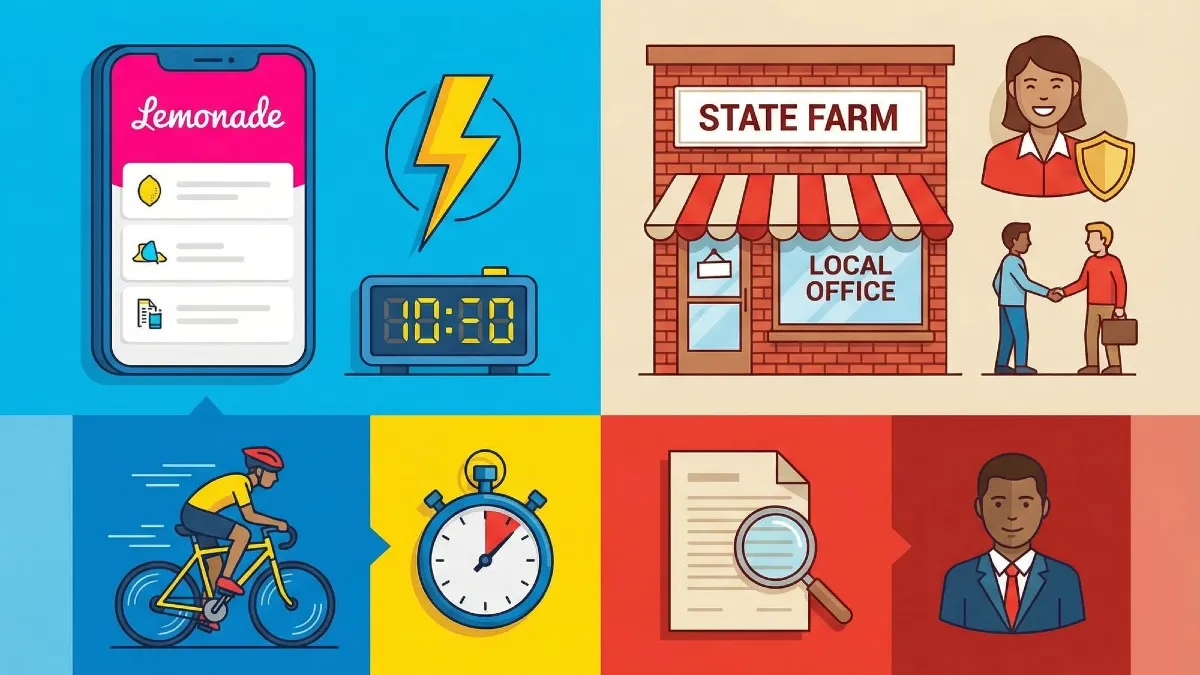
- Lemonade: The pink-colored, AI-driven app that lives in your phone and promises "90-second" policies.
- State Farm: The red-shirted giant with 19,000 agents, a century of history, and a Super Bowl commercial budget.
Most review sites will give you a generic "It depends!" answer. But that’s not helpful when you are staring at a lease agreement.
Today, we are looking at the hard data—complaint ratios, claim payout speeds, and the actual math of bundling—to declare a winner for your specific situation.
The "Vibe Check" (AI vs. Humans)
Before we talk about deductibles and liability limits, you need to understand the fundamental difference in how these two companies operate. They aren't just selling different policies; they are selling different philosophies.
Lemonade (The "Uber" of Insurance)
Lemonade is a tech company that happens to sell insurance. Their entire business model is built around behavioral economics and Artificial Intelligence.
- The Experience: You will likely never speak to a human being. When you sign up, you chat with "Maya," an AI bot. She asks you questions in a conversational style, and you can have a policy active in about 90 seconds.
- The Appeal: It feels frictionless. If you get a new camera or move to a new apartment, you open the app, tap a few buttons, and your policy updates instantly. It’s perfect for the "I hate phone calls" generation.
- The Downside: If the AI glitches, or if your situation is complex (like a fire that affects multiple units in your building), finding a human phone number can feel harder than finding a quiet spot in Times Square.
State Farm (The "Family Doctor" of Insurance)
State Farm is built on human relationships. They have the largest network of local agents in the United States.
- The Experience: When you buy a policy, you are assigned a specific agent—let's call him "Jake" (obviously). This is a real person with an office in your zip code.
- The Appeal: Reliability. If your apartment floods at 3 AM and the corporate claims adjuster is giving you the runaround, you can call your agent's office. They act as your advocate. They can pull strings that a chatbot simply cannot.
- The Downside: Signing up can feel a bit "old school." While their app has improved, you might still have to email a PDF back and forth or answer a phone call to finalize your policy details.
The Hard Data (J.D. Power & Complaints)
We don't trust marketing slogans; we trust data. In the insurance world, two major metrics matter: Customer Satisfaction (how happy people are) and Complaint Ratios (how often people get mad enough to report the company to the government).
Here is how they stacked up in the 2025 J.D. Power U.S. Home Insurance Study:
| Metric | Lemonade | State Farm | The Takeaway |
| Overall Satisfaction | 661 / 1,000 | 685 / 1,000 | State Farm ranks significantly higher in overall customer happiness. |
| Industry Ranking | #8 (Dropped from #3) | #5 (Consistent) | Lemonade's satisfaction scores have dipped as they have scaled up to millions of users. |
| Complaint Index | Higher than Avg. | Average | The NAIC (National Association of Insurance Commissioners) data shows Lemonade gets more complaints per policy than State Farm. |
The Verdict: State Farm wins on reliability. Lemonade is incredibly fast and flashy, but when things go wrong, their customers are louder about it. The "bot loops" (getting stuck in automated chat cycles) are a common complaint in 2026.
The Pricing Reality (The "Bundle" Trap)
This is where 90% of renters get tricked by marketing.
On paper, Lemonade advertises policies starting at "$5/month."
State Farm usually advertises rates starting around "$10-12/month."
Lemonade wins, right? Wrong.
If you own a car, State Farm is almost always cheaper. Why? The "Multi-Line Discount."
State Farm is aggressive about bundling. They want your car and your apartment. Because renters insurance is relatively cheap to begin with, the discount they give you on your auto insurance often subsidizes the entire cost of the renters policy.
Real Life Math Example:
Let's say you drive a 2022 Honda Civic and pay $150/month for car insurance with Geico.
- Scenario A: You buy Lemonade.
- You keep Geico for your car ($150).
- You buy Lemonade for your apartment ($10).
- Total Monthly Bill: $160.
- Scenario B: You switch to State Farm.
- You move your car to State Farm ($150).
- You add Renters Insurance ($12).
- But wait—State Farm gives you a "Multi-Line Discount" of $15 off your car bill.
- New Car Price: $135.
- Renters Price: $12.
- Total Monthly Bill: $147.
Result: In this scenario, switching to State Farm saved you $13/month total, effectively making the renters insurance better than free. If you use a tool like YNAB or Monarch Money to track your monthly recurring expenses, you’ll see that this 'free' coverage actually lowers your overall burn rate.
Key Rule: If you have a car, quote State Farm first. The bundling math is undefeated.
The Claims Process: Speed vs. Advocacy
The only reason you buy insurance is for the claim. If disaster strikes, how do these companies actually pay you?
Lemonade: The 3-Second Claim
Lemonade holds a world record for paying a claim in 3 seconds. Yes, literally three seconds.
How it Works:
You open the app and hit "Claim." You don't fill out a PDF form. Instead, you record a short video of yourself explaining what happened. ("Hi, I was at Starbucks and someone swiped my bag with my laptop in it.")
Their AI analyzes your video for fraud markers (voice stress analysis, facial micro-expressions). If the AI trusts you, it approves the claim instantly and wires the money to your bank.
It's best for small, simple thefts. If your bike gets stolen or your phone gets swiped, this is the best experience in the industry.
State Farm: The Human Safety Net
State Farm is slower. You likely won't get paid in 3 seconds.
How it Works: You file a claim online or call your agent. An adjuster is assigned to your case. They review the evidence, maybe ask for a police report, and then issue a check.
With State Farm, it’s standard. It works, but it takes 1-2 days (or weeks for complex issues). Generally, it's best for catastrophes.
For example, if your apartment building burns down and you need a hotel for 3 months, you do not want to be chatting with a bot.
You want a human agent handling that $20,000 logistics nightmare. State Farm's "Loss of Use" coverage is robust, and having a human coordinator is priceless in a crisis.
Coverage Nuances: "Zero Everything" vs. "Inflation Guard"
Both companies offer the basics: Personal Property (your stuff), Liability (if you get sued), and Loss of Use (hotel bills). But they have unique "special sauce" features.
Lemonade's "Zero Everything"
This is a paid add-on that is unique to Lemonade.
- What it is: Usually, insurance has a deductible (e.g., $500). If your $400 headphones are stolen, insurance pays nothing because it's under the deductible.
- The Perk: With "Zero Everything," you pay a higher monthly fee, but your deductible becomes $0. If your $50 flip-flops are stolen at the beach, Lemonade pays you $50.
- The Catch: You can only file two such claims a year, and it raises your premium significantly.
State Farm's "Inflation Guard"
This is a standard feature often included in State Farm policies.
- What it is: Most people buy a policy for $20,000 of coverage and forget about it for 5 years. But due to inflation, your stuff costs more to replace in 2026 than it did in 2021.
- The Perk: State Farm automatically adjusts your coverage limits up slightly every year to keep pace with inflation, ensuring you are never underinsured.
- The Catch: Your premium might tick up slightly each year to match the increased coverage.
The Final Verdict
Comparison shopping is exhausting, so let's simplify this decision tree.
Choose Lemonade If:
- You do NOT own a car. Without the car bundle, Lemonade is almost always the cheaper option for standalone renters insurance.
- You want speed. You need a policy active in 90 seconds because your landlord is demanding proof before you can move in.
- You move frequently. Lemonade’s app makes transferring your policy from one apartment to another seamless.
Choose State Farm If:
- You own a car. The bundling math is mathematically superior. You are likely throwing money away if you don't at least get a quote here.
- You want an advocate. If a claim gets denied, having a local agent ("Jake") to call is valuable.
- You have high-value items. State Farm's "Personal Articles Policy" (for engagement rings, cameras, etc.) is widely considered the gold standard in the industry for protecting expensive gear.
The Third Option?
If you want the tech-savvy vibe of Lemonade but better customer service ratings, look at Amica. They consistently rank #1 in J.D. Power studies, beating both of these giants. They are slightly more expensive, but they are the "Nordstrom" of insurance—you pay a bit more, but the service is impeccable.
Disclaimer: This review is based on this year's data. Insurance rates vary by zip code, credit score, and claim history. Always read your policy documents for exclusions.
